Home  /  For Plans, Brokers & Partners

For employers, brokers & TPAs

Built by brokers, plan vets, and PharmDs who audit every claim.

A specialty program that pays for itself — and treats people like people. Priced, executed, and audited per claim.

For Employers, Brokers & TPAs

A specialty program that pays for itself — and treats people like people.

Specialty drug spend is the line item your plan can't model and can't ignore. We are the partner that takes it on. We identify the right members through claims data, move them into a high-touch program they actually like, and price our work so the plan saves more than it pays us.

Plan member reviewing her care plan on a tablet
1

We find the members

Send us a claims feed. Our data analytics team — led by PharmDs with MSEP degrees — identifies members on specialty therapies, current and pipeline, where a Quantify model meaningfully changes cost, clinical outcome, or experience. No fishing expeditions. No member required to raise their hand.

2

We move them, gently

A nurse — not a call center — outreaches each member. We explain what we do, answer questions, coordinate with their prescriber, and only move them if it is in their interest. Members consistently tell us this part is what makes it stick.

3

We deliver the care

Home infusion, in-home injections, and specialty oral medications in all 50 states. When home isn't right, infusions in alternate ambulatory care settings close to the member, arranged by the QSC team. Specialty pharmacy through our URAC-accredited operation. Wrap-around services — dietitian, counseling, clinical pharmacist — included.

4

We report what happened

Monthly engagement reports per group: who we engaged, where they are in the program, what the plan paid, and what the plan saved versus the prior path. The same reports you'd build yourself if you had the data and the time.

A Quantify patient at home with her husband and a visiting Quantify nurse — a warm three-way conversation in golden afternoon light
Care delivered where members actually live — a nurse at the bedside, not a call center. Wrapped around the whole household.
Self-funded employer plans Our core customer. We work directly with employers and through brokers, TPAs, and stop-loss partners.
No program fees We get paid for the care we actually deliver. If we don't move a member, the plan owes us nothing for that member.
Out-of-network on purpose Staying out of network is what lets us deliver the savings. We bill the plan, we don't bill the member, and we hold ourselves to a fair-and-defensible rate the plan can audit.
EDI & email billing supported We integrate with the way your plan already works — 837/835 EDI, or partner-specific email billing where that's how a TPA prefers to work.

What it looks like on a real claim

One member. One specialty therapy. One audited episode.

Most specialty vendors will pitch you a marketing number. We will pitch you a method. The case below is a real, anonymized member receiving a real specialty therapy, audited line by line by our PharmD-MSEP team against the actual paid-claim EOB. Anonymized for member privacy. The methodology — not the portfolio — is the differentiator.

50 States with home infusion services
65+ Physical infusion clinic locations
95% Member adherence rate on therapy
350+ Specialty therapies dispensed
10–90% Savings on specialty infusions, per claim

Real claim cost comparison · 1 infusion therapy session

The Quantify cost difference

HCPCS Code Drug or Service Description Hospital cost Quantify cost
J1303 Ultomiris 1 vial – 1,100mg $845,328.00 $82,842.14
96413 IV Infusion Infusions – up to 2 hours $1,807.00 $200.00
59338 Infusion Materials Solution Infusion – 50ml Supplies $17.82 $175.00
99601 Nursing Services Nursing – up to 2 hours included
Allowable cost per session $593,006.97 $83,217.14
Total allowable cost per year (6 sessions/yr) $3,558,041.82 $499,302.84

Total annualized savings

$3,058,738.98

Percentage savings

86%

Anonymized for member privacy. One real specialty therapy claim, audited against the actual paid-claim EOB by Quantify's PharmD-MSEP team. Methodology applies to all 350+ specialty therapies in our formulary. Additional case files available under NDA.

How we audit a claim — and what we won't do

One desk, one PharmD-MSEP, one head

Every claim is reviewed by a PharmD holding an MSEP (Master of Science in Pharmacogenomics + Pharmacoeconomics). Clinical appropriateness and economic defensibility are evaluated on the same desk, on the same claim, at the same time. Not handed off between functions.

How we calculate

Allowable cost = sum of each line item on the claim (drug + administration + supplies + nursing) at the contracted rate. Savings = incumbent allowable per session minus Quantify allowable per session, annualized over the prescribed treatment cycle. Pulled from the actual paid-claim EOB, not a model.

What we don't claim

No “up to” ranges. No hypothetical PMPM. No averages inflated by removing the low end. No portfolio aggregates. Every dollar above is traceable to one HCPCS code, one drug, one paid claim, one member.

What you'll see in your own audit

Send us a de-identified specialty claim. We return a case file in the format above — per-line, per-HCPCS, with a defensible Quantify rate against your incumbent paid amount. No commitment, no fee, no obligation to switch. Typical turnaround: 7–10 business days.

Run a real claim through our methodology Send one. We'll return the audit.

How we audit your claims

Two lenses. One head. No handoffs.

Most specialty vendors split clinical review from economic review across different functions, with handoffs and lost context between them. We do it on one desk.

Every claim QSC touches goes through both reviews on the same PharmD — a pharmacist who also holds an MSEP (Master of Science in Pharmacogenomics + Pharmacoeconomics). One person, trained to evaluate clinical appropriateness AND economic defensibility together, never apart.

We never estimate acquisition cost.

Every claim is priced against actual supplier-level vial pricing. If we don't have it, we escalate. We do not extrapolate from averages or AWP discounts.

Member-centric, not drug-centric.

When we engage a member, we look at their complete specialty regimen — current and pipeline. A therapy that doesn't qualify on its own may still belong in the care plan because of what else the member is on.

Outlier protection on every claim.

Partial payments, reversals, and edge cases can mask the real economics. We use statistical guardrails so the savings number we report is the one we can actually deliver.

Frequency, validated three ways.

We annualize episodes against claims pattern AND medication label AND clinical guidelines — never just one. Frequency is the most consequential number in any specialty engagement, and most vendors get it wrong by relying on claims alone.

Documented per claim, not per deck.

Every QSC engagement comes with a clinical rationale and an economic rationale documented at the claim level. When a CFO asks “why did we save $190K on this member?” the answer is in the file, not in someone's head.

Who shows up for you

From your side of the table.

Most specialty vendors put a rep between you and the people doing the work who has never sat in your seat. We don't. Our commercial team is built from the people who used to sit across from a vendor like us — and got tired of being sold a number.

They came from plans, brokerages, stop-loss carriers, and employer captives. They know what the renewal conversation actually looks like at 4pm on a Friday. They built QSC to be the vendor they wished they had.

Former brokers who placed plans like yours.

They sat in your seat. They know which carve-out math is real and which is a slide. They know what the underwriter will accept and what the renewal will look like 24 months out.

Stop-loss veterans who priced your risk.

They came from carriers and MGUs. They speak laser, spec, agg, and disclosure fluently — and they will tell you when an engagement will or will not move the needle on your renewal before you commit.

Plan operators who lived the build vs. buy decision.

They ran plans, built RFPs, fired vendors, and signed the checks. When they say “this is the right model for your population,” it is because they have run the math on the other side — not because a CRM told them to follow up.

Captive specialists who run the math you run.

Group captives, single-parent, agency captives — we have priced inside them and reported into them. We know what your TPA owes you, what your stop-loss carrier owes you, and what the captive board will ask in November.

Measured on your savings, not on closed engagements.

Most of our commercial team is on salary, with a handful of channel partners we've worked with for years. Either way, the number that gets reviewed is the same one your CFO reviews: did the savings we promised show up in the plan's bank account? Our team will walk you through a member where we saved less than projected, an engagement that did not clear the floor, or a case where the right answer was “don't engage this member at all.” That is what showing up from your side of the table actually looks like.

8/8 Head-to-head

Score the field

Quantify wins on every question every CFO and broker should ask.

Most vendors land 3 of these. We hit 8.

Question 1

Is the specialty pharmacy URAC-accredited and named?

Quantify — owned and operated. Accredited. Licensed in the states we serve.
×
Others — usually a partner pharmacy. Often not named.
Question 2

Is the clinical team named, with credentials?

Quantify — physicians, NPs, nurses, PharmDs, dietitians, counselors. Named on this site, with credentials.
×
Others — usually a single “care guide” or coordinator. Founders listed by first name only.
Question 3

Is there third-party editorial recognition?

Quantify — featured by Healthcare Business Review as a Top Infusion Care Service Provider, 2026.
×
Others — self-issued claims. No editorial recognition.
Question 4

How are savings actually proven?

Quantify — per-episode-of-care, claims-validated. Per-line case file delivered against your incumbent paid claim.
×
Others — “up to” marketing ranges. No published case files.
Question 5

Who actually builds the pricing?

Quantify — PharmDs with MSEP degrees evaluating every engagement. Clinical and economic rigor in one team.
×
Others — data analysts, actuaries, or unnamed pricing teams. Rarely both clinical and economic.
Question 6

Are manufacturer rebates preserved for the plan?

Quantify — yes. Nothing in our acquisition path interferes with what flows back to your plan.
×
Others — often unclear. Some acquisition models quietly route around plan rebates.
Question 7

Where are the real patient voices?

Quantify — real verbatim patient quotes, monthly engagement reports, member app, 24/7 nurse line, Virtual Command Center.
×
Others — aggregate NPS figures, no published member voices.
Question 8

What does coverage and fee structure look like?

Quantify — 50-state home infusion plus alternate ambulatory care when home isn't right. No PMPM. No admin fees. No fixed retainer. The plan pays per claim for the care we actually deliver.
~
Others — 50-state home infusion. PMPM, admin fees, or pay-for-performance models common. Member billing varies.

8 for 8. Most vendors land 3.

Bring us a vendor RFP. We will fill in their column with you, line by line. Request your free claims audit →

What that looks like in practice

Real engagements. Real savings. Member experience intact.

70% savings on a high-cost oncology infusion, single self-funded plan, single member
74% savings on a rare-disease enzyme replacement, weekly dosing, two members
49% savings on a biologic for chronic gout, every-two-week dosing, one member

Every Quantify engagement is priced against the specific plan's incumbent paid amount — there is no fixed rate card, because there shouldn't be. The savings figures above were all delivered to self-funded employer plans in the past 12 months and are claims-validated per episode of care. Manufacturer rebates stayed with the plan. Members received home infusion with a nurse who stayed the entire visit. Specific case files, including the J-codes, dose schedules, and per-claim math, are available to qualified plan sponsors under NDA.

The methodology behind every Quantify engagement is the same: each line item on each claim is reviewed by a PharmD with an MSEP credential, against the actual paid-claim EOB from the incumbent network. We work across the full specialty formulary — 350+ therapies spanning neurology, immunology, hematology, rheumatology, gastroenterology, oncology, and rare conditions. Every dollar of savings we cite is traceable to one HCPCS code, one drug, one paid claim, one member. Portfolio aggregates and individual large-employer case files are available to qualified plan sponsors under NDA.

Partner reference

Questions plan sponsors ask us first.

How does Quantify integrate with a partner that already has nurse case managers?

We complement your care management program — we do not replace it. Your nurses keep the longitudinal relationship with the member. Quantify handles the specialty infusion, injection, and medication workflow end-to-end: prior auth, scheduling, medication delivery, the infusion or injection visit, 24/7 nursing on therapy-related issues, and SDOH support through dedicated Resource Coordinators. We share structured updates back to your team through a documented nurse-to-nurse handoff and post-visit notes.

What is the referral path and timing?

Referrals come in by secure online form, secure email, or fax. We need member demographics, diagnosis, prescribing provider, treatment / J-code (if known), and insurance info. Partner CM teams can refer directly; no separate provider sign-off needed at the referral stage. We acknowledge receipt within 1 business day. Member outreach (call + text) happens within 24–48 hours. Welcome call with a QSC nurse is typically within 3–5 business days.

How are members identified for the program?

We work from your claims feed. Our data analytics team — led by PharmDs with MSEP degrees — flags members on specialty therapies, current and pipeline, where the Quantify model meaningfully changes cost, clinical outcome, or experience. That clinical-plus-economic lens is what keeps the work honest: every flag has to clear both a pharmacy-clinical review and an economic-defensibility review before it becomes a recommendation. No fishing expeditions. No member is required to raise their hand. We coordinate with the prescribing provider before any clinical move.

What is the cost structure for the plan?

We are paid for the care we actually deliver. If we do not engage a member, the plan owes us nothing for that member. We stay out of network on purpose — that is what lets us deliver savings against the in-network specialty path. We bill the plan and hold ourselves to a fair-and-defensible rate the plan can audit. Member cost share depends on the plan setup; our team works manufacturer copay programs, foundation grants, and patient-assistance resources on every member's behalf to bring out-of-pocket as close to $0 as the plan allows. On HDHP/HSA plans, the IRS-minimum deductible must be met first.

How do members pay for it?

QSC patients are covered through a self-funded employer health plan. For most members, our team works hard to bring out-of-pocket as close to $0 as the plan allows — through manufacturer copay programs, foundation grants, and patient-assistance resources. On HDHP/HSA plans, federal law requires the IRS-minimum deductible be met first; on other plan types, cost share is set by the plan, and we negotiate every option to lower it. We always tell members exactly what to expect before their first dose.

What does ongoing clinical oversight look like?

24/7 nurse availability via phone, text, and the QSC member app. Daily remote monitoring of biometric data where applicable. Post-treatment notes sent to the prescribing provider after every infusion or RN visit. Care escalations follow QSC's SBAR protocolSituation, Background, Assessment, Recommendation — the same structured-communication discipline acute-care hospital teams use to hand off critically ill patients. Every escalation gets the same disciplined framing, regardless of which nurse picks up the call.

What reporting do partners receive?

A monthly engagement report per group, delivered by the 5th of the following month: who we engaged, where they are in the program, what the plan paid, and what the plan saved versus the prior path. The same reports you would build yourself if you had the data and the time.

How do we integrate billing — EDI or email?

Both. We send 837 claims and accept 835 remittance where the plan or TPA uses standard EDI. For partners who prefer email-attached billing, we support that workflow with a Quantify-branded claims workbook — same data, your format.


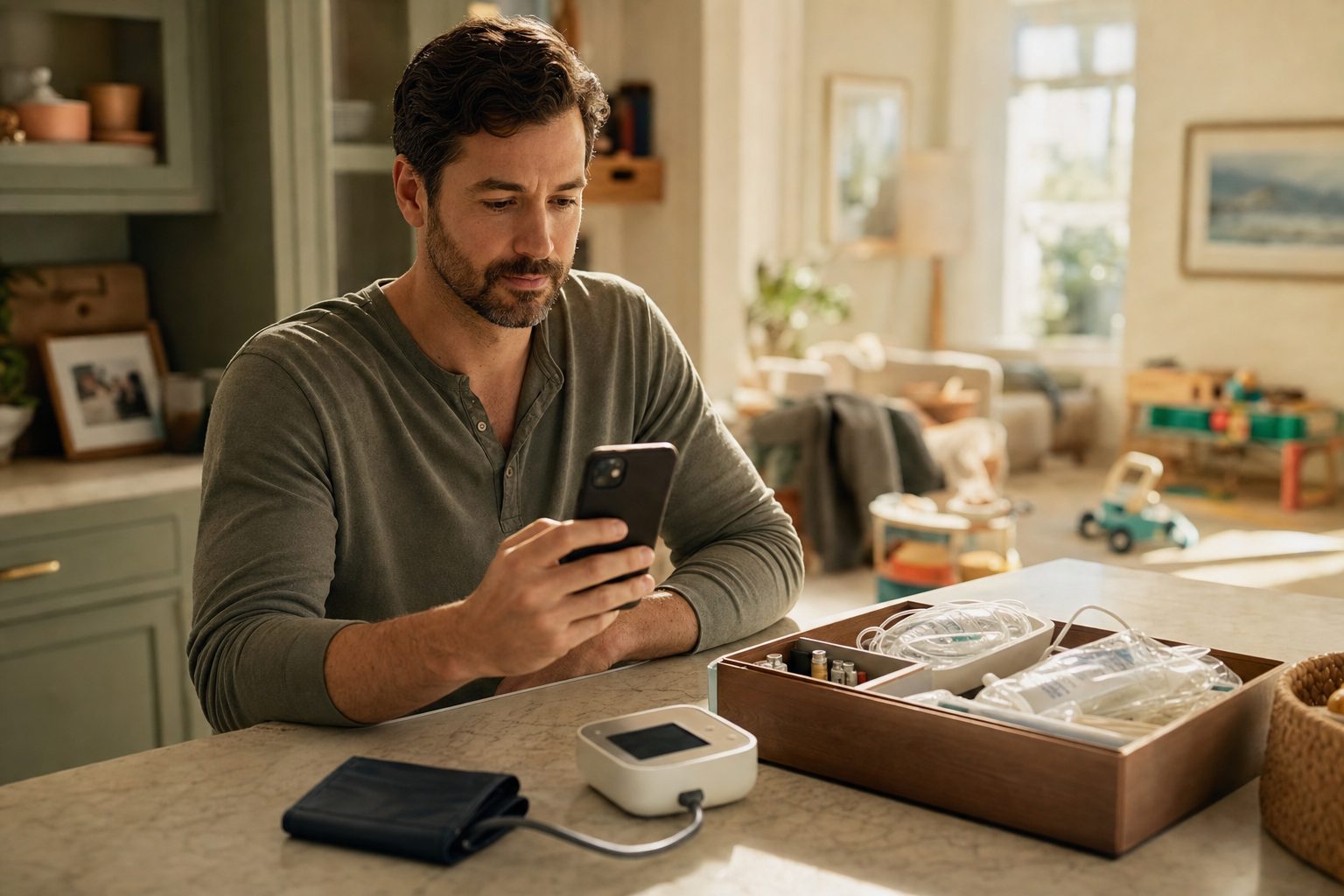
Plan member at home with his connected monitoring kit — BP cuff and supplies on the counter
Members reach us by phone, text, or app — same team picks up, day or night.

From the Plan Side

What it looks like when it works.

A forwarded note from a self-funded plan member, sent to her broker — describing what Quantify actually felt like, in her words. Names removed.

"The process has been pretty smooth. Quantify Specialty Care is handling the service. They have an app I download where they can monitor my vitals. I received a huge box with all the medications and supplies I will need. Each of my five doses has a separate package, clearly labeled with everything I will need. They provided an IV stand and pump — and I don't ship it back, so I don't even know what I'll do with this — but I didn't even think about these things.

They sent a blood pressure monitor and cuff. It links to cell service and uploads my vitals to the company, and I can also see them on the app. They want me to monitor my blood pressure at least three days before each infusion, and then right before and right after.

They called me and gathered a very thorough medical history and explained how things were going to work. The nurse who came to my office coordinated the appointment time. She is AWESOME, very professional, and nice. We have all my appointments scheduled for my convenience and hers — in my office. The actual infusion is only about twenty minutes, so this really saves me from having to rearrange my day and travel somewhere for such a short time.

They even provided a care package that included a water bottle, ice bag, some pain meds, a little notebook and some other small items with affirmations to help keep you positive. I feel a little guilty taking these things when I don't have something serious — but just imagine if you did and you received this. Oh, they included fuzzy socks.

During the infusion I received a text from the home office saying my vitals were coming through and everything was looking good. I have a message that if I wanted some guidance on iron-rich foods, they have a dietitian who can help me with that. So far, this has been a great experience."